Quality & Compliance: The Standard of Certainty
For a procurement engineer or supply chain manager, “quality” is a risk-mitigation strategy.
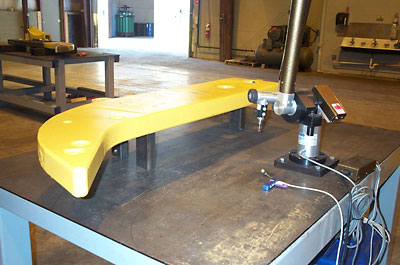
Since 1952, FMP has operated with the belief that quality isn’t a department that inspects parts at the end of the line. It is a culture that dictates how material is received, how arcs are struck, and how every thousandth of an inch is documented. Over 70 years, FMP has earned its reputation as a partner where the paperwork is as precise as the machining.
ISO 9001:2015: The System of Repeatability
FMP doesn’t just “have” ISO — the company lives it. The quality management system ensures:
- Root Cause Analysis: Non-conformances trigger system interrogation — not just fixes, but preventive corrective actions.
- Process Control: Every job follows a strictly defined traveler. No step is skipped, no operation is improvised.
- Risk-Based Thinking: Potential failure points (weld distortion, material hardening) are identified before fabrication begins.
Caterpillar Highest-Level Certification
Caterpillar’s supplier qualification process examines people, safety, financial health, and technological investment. Maintaining their highest level requires:
- PPM defect rates approaching zero
- Strict delivery window compliance
- Integrated data transparency
- Continuous improvement documentation
When FMP holds Caterpillar’s highest level, every other OEM knows they’re partnering with a shop that has already passed the most demanding evaluation in the industry.
AWS Welding Certifications
AWS D1.1 — Structural Steel The bedrock of heavy fabrication. Covers structural connections for mining, rail, and heavy machinery.
Non-Destructive Testing (NDT)
- UT (Ultrasonic Testing) — High-frequency sound waves detecting internal voids, cracks, and inclusions
- MT (Magnetic Particle) — Surface and near-surface discontinuities in ferromagnetic materials
- PT (Liquid Penetrant) — Surface-breaking defects in stainless steel and non-porous materials
Total Material Traceability
Mill Test Reports (MTRs): Every plate entering the facility is accompanied by an MTR. Chemical composition and physical properties are verified against specifications before fabrication begins.
Heat Number Tracking: Each plate is tracked through every department:
- Cutting — Heat number transferred to every individual blank
- Forming — Logged on the traveler
- Welding — Heat numbers documented for each sub-assembly
- Shipment — MTRs matched to heat numbers on delivered parts
Audit-Ready
FMP doesn’t “prepare” for audits because the facility operates in a constant state of compliance. Customer quality teams are invited to Cudahy to walk the floor, review records, and interview technicians at any time.